Search This Blog

Showing posts with label Sunday Homilies. Show all posts

Monday, March 26, 2012

Some thoughts on Passiontide

For those of you paying attention, yesterday was the Fifth Sunday of Lent, commonly called Passion Sunday (not to be confused with Palm Sunday, on which the Passion of our Lord Jesus Christ is first proclaimed).  Having noticed an outbreak of liturgical minimalism and spiritual mediocrity in my part of the world with regard to some of the most beautiful and ancient traditions that the Roman Rite has to offer vis a vis Passiontide, I submit to you some reflections from that indomitable liturgical scholar, Dom Prosper Guéranger, OSB.

During the preceding four weeks, we have noticed how the malice of Jesus' enemies has been gradually increasing.  His very presence irritates them; and it is evident that any little circumstance will suffice to bring the deep and long-nurtured hatred to a head.  The kind and gentle manners of Jesus are drawing to Him all hearts that are simple and upright; at the same time, the humble life He leads, and the stern purity of His doctrines, are perpetual sources of vexation and anger, both to the proud Jew that looks forward to the Messiah being a mighty conqueror, and to the pharisee, who corrupts the Law of God, that he may make it the instrument of his own base passions.  Still, Jesus goes on working miracles; His discourses are more than ever energetic; His prophecies foretell the fall of Jerusalem, and such a destruction of its famous temple, that not a stone is to be left on a stone.  
The doctors of the Law should, at least, reflect upon what they hear; they should examine these wonderful works, which render such strong testimony in favor of the Son of David; and they should consult those divine prophecies which, up to the present time, have been so literally fulfilled in His person.  Alas! they themselves are about to carry them out to the very last iota.  There is not a single outrage or suffering foretold by David and Isaiah, as having to be put upon the Messiah, which these blind men are not scheming to verify.  [And the same lamentable conduct that characterizes the Synagogue of the day] is but too often witnessed nowadays in those sinners, who, by habitual resistance to the light, end by finding their happiness in sin.  
Neither should it surprise us, that we we find in people of our own generation a resemblance to the murderers of our Jesus: the history of His Passion will reveal to us many sad secrets of the human heart and its perverse inclinations; for what happened in Jerusalem, happens also in every sinner's heart.  His heart, according to St. Paul, is a Calvary, where Jesus is crucified.  There is the same ingratitude, the same blindness, the same wild madness, with this difference: that the sinner who is enlightened by faith, knows Him whom he crucifies...
Everything around us urges us to mourn  The images of the saints, the very crucifix on our altar, are veiled from our sight.  The Church is oppressed with grief.  During the first four weeks of Lent, she compassionated her Jesus fasting in the desert; His coming sufferings and crucifixion and death are what now fill her with anguish...It is to express this deep humiliation that the Church veils the cross...Let us go back, in thought, to the sad day of the first sin, when Adam and Eve hid themselves because a guilty conscience told them they were naked...Our first parents sought to hide themselves from the sight of God.  But it will not be thus forever.
This Sunday is called Passion Sunday because the Church begins, on this day, to make the sufferings of our Redeemer her chief thought. 
We owe it to ourselves during this blessed Passiontide to seek to be drawn into the great salvific mystery of Christ's suffering and death by meditating day and night on how it was not the scribes and pharisees who crucified Our Lord, but our own sins--past, present, and future.  How great a mystery it is to contemplate how our sins--the very sins that scourged Him, that crowned Him with thorns, that placed a cross on His shoulders, that mocked and beat Him, that drove nails into His hands and feet, that pierced His heart with a lance--should be overcome by the very agony that they inflicted...that the great death that they brought about would ultimately be their very nullification!  

It's not too late for us all to make of this Passiontide an intense spiritual exercise by which we become more acutely aware of our sins, and by which we seek to hide ourselves from the gaze of Almighty God, that, in being truly repentant and seeking forgiveness, we might be called to that Heavenly Banquet wherein we may look upon the face of God and bask in the rays of His ineffable glory at Christ's Resurrection, and in the life to come!

(Cynical re-cap: Stop being pansies.  Veil your images.  Repent.  Acknowledge your sins.  Confess them. Gain Eternal Life.)

Saturday, February 18, 2012

MUST READ: Sermon for Quinquagesima Sunday by St. Alphonsus of Liguori

In preparation for Lent, I am posting here the text of St. Alphonsus' sermon for Quinquagesima Sunday (so-titled in the pre-1969 calendar, and the Sunday before Ash Wednesday).  -from CatholicApologetics.info

*******


SERMON XIV. QUINQUAGESIMA SUNDAY. - DELUSIONS OF SINNERS. 
"Lord, that I may see." LUKE xviii. 41. 

1. THE Devil brings sinners to hell by closing their eyes to the dangers of perdition. He first blinds them, and then leads them with himself to eternal torments. If, then, we wish to be saved, we must continually pray to God in the words of the blind man in the gospel of this day, ”Lord, that I may see." Give me light: make me see the way in which I must walk in order to save my soul, and to escape the deceits of the enemy of salvation. I shall, brethren, this day place before your eyes the delusion by which the devil tempts men to sin and to persevere in sin, that you may know how to guard yourselves against his deceitful artifices. 

2. To understand these delusions better, let us imagine the case of a young man who, seized by some passion, lives in sin, the slave of Satan, and never thinks of his eternal salvation. son, I say to him, what sort of life do you lead? If you continue to live in this manner, how will you be able to save your soul? But, behold! the devil, on the other hand, says to him: Why should you be afraid of being lost?  Indulge your passions for the present: you  will afterwards confess your sins, and thus all shall be remedied. Behold the net by which the devil drags so many souls into hell. “Indulge your passions: you will hereafter make a good confession." But, in reply, I say, that in the meantime you lose your soul. Tell me: if you had a jewel worth a thousand pounds, would you throw it into a river with the hope of afterwards finding it again? What if all your efforts to find it were fruitless? God! you hold in your hand the invaluable jewel of your soul, which Jesus Christ has purchased with his own blood, and you cast it into hell! Yes;  you cast it into hell;  because according to the present order of providence, for every mortal sin you commit, your name is written among the number of the damned. But you say . ”I hope to recover God‟s grace by making a good confession." And if you should not recover it, what shall be the consequences? To make a good confession, a true sorrow for sin is necessary, and this sorrow is the gift of God: if he does not give it, will you not be lost for ever? 

3. You rejoin: ”I am young; God compassionates my youth; I will hereafter give myself to God." Behold another delusion! You are young; but do you not know that God counts, not the years, but the sins of each individual?  You are young;  but how many sins have you committed?  Perhaps there are many persons of a very advanced age, who have not been guilty of the fourth part of the sins which you have committed. And do you not know that God has fixed for each of us the number of sins which he will pardon?”The Lord patiently expecteth, that, when the day of judgment shall come, he may punish them in the fulness of their sins." (2 Mach. vi. 14.) God has patience, and waits for a while; but, when the measure of the sins which he has determined to pardon is tilled up, he pardons no more, but chastises the sinner, by suddenly depriving him of life in the miserable state of sin, or by abandoning him in his sin, and executing that threat which he made by the prophet Isaias”I shall take away the hedge thereof, and it shall be wasted." (Isa. v. 5.) If a person has cultivated land for many years, has encompassed it with a hedge for its protection, and expended a large sum of money on it, but finds that, after all, it produces no fruit, what will he do with it? He will pluck up the hedge, and abandon it to all men and beasts that may wish to enter. Tremble, then, lest God should treat you in a similar manner. If you do not give up sin, your remorse of conscience and your fear of divine chastisement shall daily increase. Behold the hedge taken away, and your soul abandoned by God a punishment worse than death itself. 

4. You say: ”I cannot at present resist this passion." Behold the third delusion of the devil, by which he makes you believe that at present you have not strength to overcome certain temptations. But St. Paul tells us that God is faithful, and that he never permits us to be tempted above our strength. "And God is faithful, who will not permit you to be tempted above that which you are able." (1 Cor. x. 13.) I ask, if you are not now able to resist the temptation, how can you expect to resist it hereafter? If you yield to it, the Devil will become stronger, and you shall become weaker; and if you be not now able to extinguish this flame of passion, how can you hope to be able to extinguish it when it shall have grown more violent? You say: "God will give me his aid." But this aid God is ready to give at present if you ask it. Why then do you not implore his assistance? Perhaps you expect that, without now taking the trouble of invoking his aid, you will receive from him increased helps and graces, after you shall have multiplied the number of your sins? Perhaps you doubt the veracity of God, who has promised to give whatever we ask of him?”Ask," he says, ”and it shall be given you." (Matt. vii. 7.) God cannot violate his promises. ”God is not as man, that he should lie, nor as the son of man, that he should be changed. Hath he said, then, and will he not do ?"(Num. xxiii. 19.) Have recourse to him, and he will give you the strength necessary to resist the temptation. God commands you to resist it, and you say: ”I have not strength." Does God, then, command impossibilities? No; the Council of Trent has declared that”God does not command impossibilities; but, by his commands, he admonishes you to do what you can, and to ask what you cannot do; and he assists, that you may be able to do it." (Sess. 6. c. xiii.) When you see that you have not sufficient strength to resist temptation with the ordinary assistance of God, ask of him the additional help which you require, and he will give it to you; and thus you shall be able to conquer all temptations, however violent they may be. 

5. But you will not pray;  and you say that at present you will commit this sin, and will afterwards confess it. But, I ask, how do you know that God will give you time to confess it? You say: ”I will go to confession before the lapse of a week." And who has promised you this week?  Well, then you say: ”I will go to confession  tomorrow." And who promises you tomorrow? “Crastinum Deus non promisit," says St. Augustine, ”fortasse dabit, et fortasse non dabit." God has not promised you to-morrow. Perhaps he will give it, and perhaps he will refuse it to you, as he has to so many others. How many have gone to bed in good health, and have been found dead in the morning! How many, in the very act of sin, has the Lord struck dead and sent to hell! Should this happen to you, how will you repair your eternal ruin?”Commit this sin, and confess it afterwards." Behold the deceitful artifice by which the devil has brought so many thousands of Christians to hell. We scarcely ever find a Christian so sunk in despair as to intend to damn himself. All the wicked sin with the hope of afterwards going to confession. But, by this illusion, how many have brought themselves to perdition! For them there is now no time for confession, no remedy for their damnation. 

6. ”But God is merciful." Behold another common delusion by which the devil encourages sinners to persevere in a life of sin! A certain author has said, that more souls have been sent to hell by the mercy of God than by his justice. This is indeed the case; for men are induced by the deceits of the devil to persevere in  sin, through confidence in Gods mercy; and thus they are lost. "God is merciful." Who denies it? But, great as his mercy, how many does he every day send to hell? God is merciful, but he is also just, and is, therefore, obliged to punish those who offend him. ”And his mercy," says the divine mother, ”to them that fear him."(Luke i. 50.) But with regard to those who abuse his mercy and despise him, he exercises justice. The Lord pardons sins, but he cannot pardon the determination to commit sin. St. Augustine says, that he who sins with the intention of repenting after his sins, is not a penitent but a scoffer. ”Irrisor est non pœnitens." But the Apostle tells us that God will not be mocked. ”Be not deceived; God is not mocked." (Gal. vi. 7.) It would be a mockery of God to insult him as often and as much as you pleased, and afterwards to expect eternal glory. 

7. "But”; you say, "as God has shown me so many mercies hitherto, I hope he will continue to do so for the future." Behold another delusion! Then, because God has not as yet chastised your sins, he will never punish them! On the contrary, the greater have been his mercies, the more you should tremble, lest, if you offend him again, he should pardon you no more, and should take vengeance on your sins. Behold the advice of the Holy Ghost: ”Say not: I have sinned, and what harm hath befallen me? for the Most High is a patient rewarder." (Eccles. v. 4.) Do not say: ”I have sinned, and no chastisement has fallen upon me." God bears for a time, but not for ever. He waits for a certain time; but when that arrives, he then chastises the sinner for all his past iniquities: and the longer he has waited for repentance, the more severe the chastisement. ”Quos diutius expectat," says St. Gregory, ”durius damnat." Then, my brother, since you know that you have frequently offended God, and that he has not sent you to hell, you should exclaim: ”The mercies of the Lord, that we are not consumed." (Thren. iii. 22.) Lord, I thank you for not having sent me to hell, which I have so often deserved. And therefore you ought to give yourself entirely to God, at least through gratitude, and should consider that, for less sins than you have committed, many are now in that pit of fire, without the smallest hope of being ever released from it. The patience of God in bearing with you, should teach you not to despise him still more, but to love and serve him with greater fervour, and to atone, by penitential austerities and by other holy works, for the insults you have offered to him. You know that he has shown mercies to you, which he has not shown to others. ”He hath not done in like manner to every nation." (Ps. cxlvii. 20.) Hence you should tremble, lest, if you commit a single additional mortal sin, God should abandon you, and cast you into hell. 

8. Let us come to the next illusion. “It is true that, by this sin, I lose the grace of God; but, even after committing this sin, I may be saved." You may, indeed, be saved: but it cannot be denied that if, after having committed so many sins, and after having received so many graces from God, you again offend him, there is great reason to fear that you shall be lost. Attend to the words of the sacred Scripture: “A hard heart shall fare evil at the last." (Eccles. iii. 27.) The obstinate sinner shall die an unhappy death.  Evil doers shall be cut off." (Ps. xxxvi. 9.) The wicked shall be cut off by the divine justice. “For what things a man shall sow, those also shall he reap."  (Gal. vi. 8.) He that sows in sin, shall reap eternal torments. “Because I called and you refused, I also will laugh in your destruction and will mock when 
that shall come to you which you feared." (Prov. i. 24, 26.) I called, says the Lord, and you mocked me; but I will mock you at the hour of death. “Revenge is mine, and I will repay them in due time." (Deut. xxxii. 35.) The chastisement of sins belongs to me, and I will execute vengeance on them when the time of vengeance shall arrive. “The man that with a stiff neck despiseth him that reproveth him, shall suddenly be destroyed, and health shall not follow him."  (Prov. xxix. 1.) The man who obstinately despises those who correct him, shall be punished with a sudden death, and for him there shall be no hope of salvation.

9. Now, brethren, what think you of these divine threats against sinners? Is it easy, or is it not very difficult, to save your souls, if, after so many divine calls, and after so many mercies, you continue to offend God?  You say:  “But after all, it may  happen that I will save my soul." I answer: "What folly is it to trust your salvation to a perhaps ? How many with this “perhaps I may be saved,"  are now in hell?  Do you wish to be one of their unhappy companions? Dearly beloved Christians, enter into yourselves, and  tremble; for this sermon may be the last of Gods mercies to you. 

Monday, January 23, 2012

Homily Special Edition: The Right to Life


Below are notes from a homily given this weekend.  

*******

This day, for the thirty-ninth year, a cold shiver runs down the back of our great nation as, once again, we commemorate the supreme failure of our government to uphold the most fundamental—and dare I say, inalienable—right that has been endowed upon our race by Almighty God: the Right to Life.  I am speaking, of course, of the US Supreme Court’s 1973 decision which resulted in the legalization of abortion in the United States.

Contrary to what many think—and what I’m sure many sitting in these very pews today believe—issues of Life are not...I repeat...ARE NOT a political issue.  Government does not give life.  Politics does not give life.  In our time, fueled by pundits claiming to support the “health” and “rights” of women, lawmakers and politicians have placed human life in a strangle-hold, ransoming it for their own designs, and, in the process, denying the citizenry of the possibility of any longer adhering to a consistent Ethic of Life that Thomas Jefferson defined so eloquently in our own Declaration of Independence: “We hold these truths to be self-evident: that all men are created equal.”  And yet it is that same government, “of the people, by the people, and for the people,” that restricts the very life that is ours by Divine Right.  For who but God alone can create life?  Who but God alone endowed humanity with the ability to procreate, that we might share in our Master’s joy of creating that which is good?  Who but God alone?  No man.  No woman.  No politician.  No government.  Who, but God alone?

The promotion of a consistent Ethic of Life, then, is neither the purview, nor the responsibility, of elected officials, but of those who do the electing.  And I dare say that, in no small manner, we—Catholics—are partially responsible for permitting the atrocities of abortion, euthanasia, contraception, and unjustified execution to prevail in our society.  Do the math.  Almost 25% of the electorate in this nation is Catholic.  The largest single constituency in the United States of America consists of baptized, confirmed, and professed Catholics!  

Now before anyone decides to start writing letters to the Bishop or the IRS, this is NOT a politically-driven homily.  I am not advocating one political party’s platform over another, nor offering criticism of the present or past administrations.  Because, as I have said, Issues of Life are not political issues.  They are MORAL issues.

It is the moral obligation of every Catholic to form his or her conscience according to the precepts of the Gospel and the teachings of the Holy Catholic Church.  This foresees—and, dare I say, requires—the assent of believing Catholics to the doctrine of the Church.  I have yet to figure out where it is written, or who started saying, that it’s OK to pick and choose which teachings of the Church you want to believe in.  It’s not OK.  In fact, it might even be said to be sinful

True, on certain issues, the Church concedes a tiny bit of latitude.  But “Catholic” is not just a label that we slap on a variety of different “belief packages” so as to include as many people as possible.  That’s not our mission!  And it is not for individuals to tailor the one, holy, catholic, and apostolic Faith to their needs, desires, lifestyles, and political opinions.

To be Catholic is to uphold the dignity of all human life, from the moment of conception until natural death.  This is a moral imperative given to us not by a pope or bishop or pastor, but by God Himself.  The Church continues to grow in her understanding of social issues, but always toward a more consistent position in favor of human life.  For if we are not in favor, then we must be against!

We must never permit ourselves to be duped into submitting to political agendas, for we have a higher calling—a calling to holiness, a calling to true Christian charity, a calling to love our neighbors, and to build up the Body of Christ.  Our goal, as Catholics, must be step back from the political arena, and to decide for ourselves, based on the clear, non-negotiable, and infallible teaching of the Church that all human life is sacred.  This is our Faith.  This is the Faith that Jesus Christ, the only-begotten Son of God, handed on to his Apostles, and that has been transmitted to us throughout these 2,000 years of Christendom! 

Three points, and I’m finished.

First of all, the Catholic Church is not a hate-filled institution.  Our mission is to focus on the Gospel of Life, of Mercy, of Justice.  We must vehemently oppose sin at all times—most especially those sins which are inflicted upon the most vulnerable of our society—but always with love, compassion, and pity for the sinner.  For we, too, are sinners, and have no right to judge.

Second, we must work to dispel the myths that are propagated by opponents to the Pro-Life movement through sound reasoning and true charity.  There are so many slogans that float around that make abortion seem so reasonable and tolerable.  For example, the term “Pro-Choice” is constantly bandied around, as if “choice” is a viable alternative to “life.”  But choices can be both good and bad, right?  Not all choices are healthy, nor are they safe, nor are they moral.  Some choices, while they might exist, ought not be choices at all!  The phrase “Pro-Choice” certainly doesn’t point to that which is being chosen, and it would never be applied to child abuse or violent crime.  Some choices have victims.  And isn’t it a simple and fundamental matter of justice that the desires of one must end where the rights of another begin? (h/t to Priestfor Life for these observations)

Third, to consider Issues of Life, we, as a society, must look to our past.  We have overcome so many injustices in our nation, all in favor of the dignity of the human person.  Women’s suffrage.  Abolishing child labor.  Civil Rights and the end of slavery. 

Let's look at Slavery just briefly...the enslavement, buying, selling, trading, and abuse of an entire race of people just because of the color of their skin, devalued and treated as objects and commodities, stripped of all semblance of human dignity.  Are we not doing the same thing now, with regard to the unborn, the elderly, the terminally ill, and those who do not seem to be “valuable” to society?  Can it really be said that we, as a people, have truly progressed that much at all?

I close with the words of Harriet Beecher Stowe, from her “Concluding Remarks” in Uncle Tom’s Cabin:

But what can any individual do?...There is one thing that every individual can do—they can see to it that they feel right.  An atmosphere of sympathetic influence encircles every human being; and the man or woman who feels strongly, healthily and justly on the great interests of humanity, is a constant benefactor to the human race.  See, then, to your sympathies in this matter!  Are they in harmony with the sympathies of Christ?  or are they swayed and perverted by the sophistries of worldly policy?

A day of grace is yet held out to us.  Both North and South have been guilty before God; and the Christian Church has a heavy account to answer.  Not by combining together, to protect injustice and cruelty, and making a common capital of sin, is this Union to be saved—but by repentance, justice, and mercy; for, not surer is the eternal law by which the millstone sinks in the ocean, than that stronger law by which injustice and cruelty shall bring on nations the wrath of Almighty God!

*******

Today, tens of thousands of people from all races, religions, economic backgrounds and demographics will march on Washington DC in the March for Life.  We owe them our prayers, that their witness will not go unnoticed.  The mainstream media will not cover this event because it does not serve their purpose or agenda.  But we know that they are there...over 200,000 of them, peacefully demonstrating on behalf not just of the unborn, but of the terminally-ill, the mentally handicapped, and all our fellow human beings who are marginalized and devalued as human persons because they are not "productive" or "valuable" to our society.  We owe them our prayers, because they speak for those who have no voice.  We owe them our prayers because they are standing up for Truth.  We owe them our prayers because we should be there with them!

Wednesday, November 30, 2011

A Potter that's not Harry!: Homily for the First Sunday of Advent


We begin our Advent pilgrimage this year with a reading from the 63rd chapter of the prophecy of Isaiah.  But first, a little context…

Isaiah is writing at the time of the Babylonian exile--a particularly dark period in the history of the Jewish people.  The Babylonians had completely decimated the population; they destroyed the Temple at Jerusalem, slaughtered livestock, and imprisoned the Israelites, carrying them off to a foreign land as slaves.  The outlook for many of the Jews at this time was beyond bleak.  And it is from this scenario that Isaiah relates the cry of the Israelites--their cry of sheer desperation and agony, praying to their God for deliverance: Lord, tear open the heavens, and come down to save us!  Break the barrier of that which separates us from you and, with the might of your arm, deliver us!  It is a heart-rending plea for salvation.

Yet the Israelites know what it is to wait.  And despite their desperation, they liken their trials as like being clay in the hands of a master potter.  For those of you who have never worked with clay, it is not easy.  It involves a great amount of precision and work on the part of the potter.  But the expert craftsman can take all but the hardest, most brittle clay and do amazing things with it.  The clay has little to do other than cooperate by being pliable and retaining its moisture.  This is, of course, a perfect analogy for the soul of the Christian during Advent.

God, our Lord and Master, is a potter of immense skill.  And he works amazing deeds through us, as we turn on His wheel.  However, we must be pliable, we must be docile.  Our ability to be formed according to the will of the Father necessitates our cooperation with His will.  Because clay that works against the hands of the potters soon breaks under the weight of the potter's hand!  

Advent is a season of preparation--of prayer, of penance, of fasting and of good works.  But most of all, it is a season in which we permit the hands of God to work in our lives to make our souls ready--ready for the immense joy of the coming of His Son, the sweet Lord Jesus!  Because, the reality of Jesus' birth is not merely an historical fact, but an event that takes place outside of time and space.  We do not simply commemorate an event--we re-live the great mystery of the Incarnation in a manner that transports us beyond merely the physical!  And so we must be made ready!  

We use this period of Advent to permit God to work on us--to mold us--to shape us according to His will--to make of us a vessel that is both worthy and able to receive the great mystery of the Incarnation--Love in the flesh!  

But we cannot expect to be formed according to the will of God when we presume to place demands on Him.  The clay does not make demands of the potter!  We do not insist on being pushed in one direction, or pulled in another; to be permitted to do one thing, and given license to avoid something else.  No!  As clay in the hands of the potter, we can only seek to be worthy to receive God's gift by allowing the potter to mold us.  Our role is to be passive, to be docile--to take what is given to us by God, both good and bad.  And it is in the silence of this spiritual passivity that God comes to us and enables our hearts and minds to receive the gift of His Incarnate Son, and to mold us into vessels that are able to contain the great Mystery that we so eagerly anticipate.

May this Advent Season be for us a season of interior peace and stillness.  May we be given the grace to be docile and easily molded by the hands of our Divine Potter.  And may our prayer be that same heart-felt prayer cried out to the heavens by the Israelites so many years ago in Babylon: LORD, TEAR OPEN THE HEAVENS AND COME DOWN TO SAVE US!

Come, Lord Jesus!  Come into our midst!

Monday, November 21, 2011

The Coming of Our King: Homily for the Solemnity of Christ, King of the Universe


Today we celebrate the Solemnity of Christ, King of the Universe.  As our cycle of readings over the past couple of months has grown more intense in preparing us for the coming of the Kingdom of God, today we reach the pinnacle of our Liturgical Year, the climax to which we have been building over these past several weeks.

The Solemnity of Christ the King is relatively new to the Catholic liturgical calendar, even though we have celebrated the Kingship of Our Lord since the earliest of times.  The Feast was formally instituted for the Great Jubilee Year of 1925 by Pope Pius XI.  This feast was partially established in solidarity with the Catholic Church of Mexico that was undergoing fierce persecution during the Mexican Revolution.  The people of the Yucatan have always had a great devotion to Christ as King, and it was the acclamation “Vivo Cristo Rey” (“Long live Christ the King”) that echoed along with the sounds of guns as Catholic priests were tortured and executed by firing squads solely for preaching the Faith. 

The placement of the Feast was originally on the last Sunday of October. Part of the reasoning for this was to create a sort of Sacred Triduum of the Kingdom of Heaven (as opposed to the Sacred Triduum of Holy Week, which celebrates the Kingdom of God on Earth and our Salvation).  First there was the Feast of Christ the King, celebrating the Head of the Kingdom of God.  Next, the Feast of All Saints, celebrating the Heavenly Host and the Company of the Saints.  And finally, the Feast of All Souls, on which we pray for all those who have passed from this world and await reception into the Heavenly Kingdom.  Three big feasts, all geared towards the celebration of the Heavenly Kingdom.

In the current Church calendar, we celebrate the Feast of Christ the King on the last Sunday of Ordinary Time, just before the beginning of Advent.  And on some level this is just as fitting, because what is Advent all about?  It is about the birth of the Savior, the coming of the King, the coming of Emmanuel--God with us.  How appropriate to announce first the Kingdom of God, and then to prepare for it—rather like John the Baptist, who went about in the time of Jesus, proclaiming the Kingdom of God was at hand, and urging people to repent and prepare the way of the Lord!  The Feast of Christ the King is, for us, a springboard, of sorts, into the blessed season of Advent.  But without getting too far ahead in the liturgical year, what sort of King are we announcing?

Our King was born in a lowly stable, laid in a manger, and visited by shepherds and livestock.  He was raised in Nazareth, where he grew up in the normal Jewish fashion, probably learning to be a carpenter like Joseph.  He was not rich.  Most likely he had a rudimentary education commensurate with his state in life.  And then what?  He goes around preaching and proclaiming the Kingdom of God.  And our King, condemned to death by his own people who heralded him as the Messiah—the Chosen One of God—was led to his passion and death on the Hill of Calvary, executed as a common criminal…crucified…pierced with a spear…and laid to rest in a tomb that was not even his own.  What an unlikely king we have!  His cloak is torn from his body and given away by gambling.  He wears a crown on his head—not of gold, but of thorns.  And he reigns not from a throne of gold and ivory, but of bare wood…nailed to it in the shape of a cross.  Mocked.  Beaten.  Bruised.  Broken.  This is our King.

What sort of King would undergo such treatment for His subjects, but one whose love is so far outside the realm of human understanding that He would suffer so terribly, bearing our sins!

But the salvation that is won for us by our King is not free!  As we are told in the Gospel today, our Salvation is conditional upon  our relationship to the "least" of our brothers.  Jesus gives us the list of the Corporal Works of Mercy as a guide for how to relate to others, and to build up the Kingdom of God among the Christian Faithful.  Faith is not enough, if we do not put it into practice by helping those who are unable to help themselves.  And as we see Christ in all our brothers and sisters, our willingness to put them first, to do for them what they cannot do for themselves, is an expression of our love for Christ, our love for the Faith He has given us, and that which effects our admission into Christ's Heavenly Kingdom.

Friends, today we celebrate the Kingdom of God in our midst.  For it is here among us.  And from it, we await our great King, whom we welcome in just a few short weeks.  May the grace of the Kingdom of God implant itself in our hearts and compel us to articulate with all the Christian Faithful, from the innermost recesses of our hearts, with joy, fervor, and desire, that great acclamation: Come, Lord Jesus!  Come into our midst!

Investing in the Gift of Faith: Homily for the XXXIII Sunday of Ordinary Time


The Gospel for the Thirty-Third Sunday of Ordinary Time comes to us again from the 25th chapter of Matthew, incidentally right after last week’s reading.  In this parable, Jesus describes three servants who are each given a share of their master’s wealth.  To one, five talents are given, to another two, and to a third one.  The master leaves for a journey, and when he returns he seeks an account of what the servants have done with his money.  We all know the story.  The first two have taken their talents and doubled their money.  But the third, afraid of his master, who is a demanding individual, takes his talent and buries it, rather than risking it through investment.

As we said some time ago, a talent was no negligible amount of money.  Each talent was equivalent to 1,000 silver pieces.  So these servants are entrusted with a great deal of responsibility. 

We must be careful not to impose our English language on this Gospel and think too closely about monetary talents and our own personal talents.  Although this is a very common route to take, I want to steer us in a different direction.

Keep in mind that over the past couple of months, our cycle of readings has increasingly focused on the Kingdom of God, the coming of the Lord, and the day of reckoning that is to come.  Jesus continually exhorts his disciples to be reading, for we do not know when our Lord will come again.

If we look at last week’s Gospel in terms of actualizing our Faith through that profound interior movement of the spirit and seeking to participate actively in the Christian community, then today’s Gospel reinforces that by exhorting us to grow deeper in our Faith.

By virtue of our Baptism, each of us has been entrusted with a precious gift, the gift of Faith.  Our Master, the Lord God, gives us all Faith.  This Faith, friends, is indeed a gratuitous gift, given freely by our Lord, and is not our own.  It does not belong to us, nor is it a personal faith, because it is the Faith of the Church—the whole body of Christ’s Faithful; and it is the role of the Church to safeguard this tremendous Gift of Faith from abuse and misuse, from heresy and misinterpretation.  Our Faith is not a personal possession that can be manipulated or distorted according to our whims, in order to suit our own needs.  And Jesus’ parable makes that very clear.  For at every point in the story, it was the master’s money, and not the servants’.  And so, this Gift that God gives to His children is one which requires us to be faithful stewards, but never to presume ownership to where we might misuse it.

And God does not give this gift equally to everyone, does he?  No.  There are effectively three typologies of faith-filled people.  The first is represented by the servant who was given five talents.  These are the people that we all strive to be like, but whom we rarely encounter in our daily lives—the sort of people from whom holiness seems to emanate.  Their Faith is so apparent that we know them just by seeing them!  The second is the group that most of us fall into—the servant with two talents.  This is the average person of Faith, who does what is expected of him, but little more.  This person attends Mass on all Sundays and Holy Days of Obligation, obeys the Ten Commandments and the Precepts of the Church, and would be considered the average, good Catholic.  Then there is the third—the wicked, lazy servant who squanders the gift of Faith by burying it, giving it no opportunity to grow.  (Chances are, none of them are reading this blog!)

So, God gives us all the Faith, but not in equal measure.  As Jesus says very explicitly in the Gospel today, the master gave the talents to his servants, “to each according to his ability.”  Who knows better our strengths and weaknesses than God?  And He gives us Faith according to our ability to actualize our Faith.  To those to whom much Faith is given, God expects great things.  To those to whom He gives little, he still expects a return on his investment, but does not expect the same level of performance as those with more.  That would be unjust. 

We know that God is truly just, and His justice is most evident in the reward of actualizing our Faith and making it grow.  To the first two servants, he says the exact same thing: “Well done, my good and faithful servant...Come, share your master’s joy.”  Despite the fact that one servant made so much more money than the other, their reward is the same, because the reward of Faith is the same for all God’s faithful servants: the joy of Salvation!

This is the end for which we are created—eternal life sharing in the joy of God.  Our God, who is all-loving and infinitely just prepares a place for his faithful children.  Because God Himself is pure joy, it is only fitting that, wanting us to share in His life, He welcomes us into his joy.  This joy, which knows no bounds, is the same for all—whether we have a super-abundance of Faith, or whether we just barely squeak by!  In this lies the reality of the vision that God has for all of humanity, and so wide is his mercy that only the most wretched, wicked and lazy—those who squander the gift of Faith and do nothing with it whatsoever—are left to languish in the dark, bleak turmoil of eternal damnation.

We must constantly be on our guard, though.  We can never become so lazy in the Faith that we begin to squander our great Gift.  What is necessary is that each of us to whom Faith has been given seeks daily to comprehend the amount of Faith given, and to know that which is necessary to make that Faith grow into an investment worthy of our master’s praise, that on His return he will see what we have done with His Gift to us, and will welcome us into His Kingdom with the phrase our souls so desperately long to hear: “Come.  Share in your Master’s joy.”

Actualizing the Faith: Homily for the XXXII Sunday of Ordinary Time


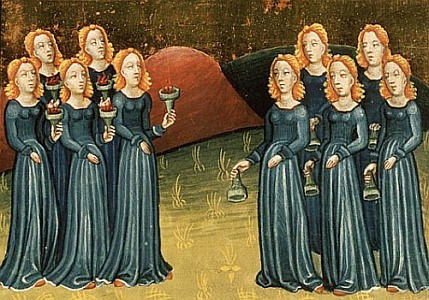
Friends, the Gospel reading for the Thirty-Second Sunday of Ordinary Time comes to us from Matthew 25:1-13, and it centers around the familiar parable of the ten virgins awaiting the bridegroom.  Five of them bring enough oil for their lamps, and five of them don’t.  And while the five foolish virgins are off trying to find oil, the Bridegroom comes, and they are not allowed into the wedding feast. 

To understand better the scene that is set before us by Jesus, we first need to understand a bit about ancient Jewish wedding ritual, because Jesus is giving this parable to people who understand very clearly what is going on, and what the significance of these ten virgins is.  First of all, the primary focus of the wedding at this time was not the bride, as it is today, but rather the bridegroom.  On an appointed day, usually at night, the Bridegroom would gather at his home with all of his family and friends, and they would parade through the streets of the village to the home of his betrothed, where she awaits him with all of her family and friends, and her bridesmaids (in this case, the ten).  Upon arrival, the entire wedding party would then process back to the home of the bridegroom (hence the common expression about a bridegroom taking a woman into his home).  Symbolically, upon entering, the couple is married, and it is inside the bridegroom’s home that the wedding ceremony takes place, followed by a great wedding feast.

Now, keep in mind that all of this takes place roughly 1,900 years before the electric light.  Homes were not well-lit as they are today, because oil and candles were expensive.  And there were no street lamps, illuminated shop signs, etc.  Walking through the streets of a village at night was dangerous, and the darkest darkness one could experience.  With no ambient light, the light of the bridesmaids carring lamps was not just decorative.  It was critical to the success of the wedding procession!  So, for the people hearing this parable, their first thought must have been one of astonishment that half of the virgins didn’t bring enough oil.  Because in this context, only a fool would go out without enough oil for a lamp!

The Fathers of the Church, in their commentaries on this Gospel, have a variety of opinions as to the significance of these lamps, and I would like to mention on one such opinion—that of St. Gregory the Great.  He writes that the lamps of the virgins represent the faith of the individual, and the oil is the good works that fuel one’s faith.  But rather than expand upon this, I’d like to offer an alternative, namely that the lamps are the souls of the faithful, and the oil is the Faith itself.  This Faith is what illumines and brightens the human soul, making it more than merely a decorative piece.  And when filled to its capacity, the Faith of the soul shines so bright as to give illumination to others.  This brightness conquers the darkness that, at times, can be so overwhelming as to cause despair and sin.

The Second Vatican Council, in its Constitution on the Sacred Liturgy (Sacrosanctum Concilium), talks about the need for participation in the Sacred Liturgy that is “full, conscious, and active.”  This is one of the most highjacked and misused phrases in any of the documents of the Ecumenical Council, precisely because of a misconception of the true nature of the word “active.”  In Latin (the language of the Council), there are two words that mean “active,” and there is but a subtle difference between the two.  The first is activa, which means active in the most common sense of doing things with great activity and motion.  Actuosa, on the other hand, is a bit more subtle.  It is where we get the word to actualize, to bring to full potential.  While it still means “in a lively manner” and “full of activity,” the sense of the word is such that it implies more of an interior movement of zeal and passion, rather than simply “doing.”  What the Fathers of the Council were trying to do was exhort the Christian Faithful not to be so overburdened by doing in the Sacred Liturgy that they lose sight of the profound interior movement of the spirit that ought to accompany liturgical action.  How many times have we heard someone suggest that if we don’t sit down, stand up, kneel, raise our arms, sing the hymns, make the responses, etc., that we’re not “actively participating” in the Mass.  But this is precisely the utilitarian understanding of the Mass that the Fathers of the Council wanted to avoid.  It’s not about idly doing, just going through the motions.  There is no meaning in that.  There must be that actuosa, that profound interior movement of the spirit that compels one to act, and to act with great zeal and devotion!
 
But let’s expand this idea beyond the realm of the Sacred Liturgy, and apply it to the Christian Life in general.  This whole concept of actualized Faith is so intrinsic to living the Gospel in a radical way.  And this is where we touch back with the parable of the ten virgins.  With the oil as the light of Faith, we can see how the lamp (that is, one’s soul) is only brought to its fullest potential, or actualized, through the light of Faith.  And it is crucial that we continue to seek to deepen this interior movement of the Spirit as a means to ensuring that the level of oil in our proverbial lamps remains adequate enough to give us the light to see along the dark path.

Friends, it’s not enough for us merely to use the oil that we have, because the longer and brighter it burns, the more is consumed.  We must carry with us an endless supply (like the five wise virgins) that is only obtained through the grace of the Sacraments and the life of the Church that sustains the Christian believer.  And this Faith, which gives off light, will radiate from us only when our lamps are continually filled.  It shines through us, and illumines the way for others!  But not without that profound interior movement of the Spirit.

May God give us all the grace to seek to actualize our Faith, not merely going through the motions, but actively seeking to participate in the life of the Church in a meaningful way, and to strive to tap into that deep interior movement of the Spirit within us that makes our Faith shine as a light for all we meet!

Thursday, November 10, 2011

Walk the Line, but Don't Cross it!: Homily for the XXXI Sunday of Ordinary Time

I realize this is very late, and I apologize.  More often than not, life gets out of hand.  (I suppose it would help if I wrote these things down to begin with, but that wouldn't be nearly as much fun!)

*******


A couple of weeks ago, in the Gospel reading for Sunday, October 30, Jesus exhorts his followers with these words:  

The scribes and the Pharisees
have taken their seat on the chair of Moses.
Therefore, do and observe all things whatsoever they tell you,
but do not follow their example.
For they preach but they do not practice.
They tie up heavy burdens hard to carry
and lay them on people's shoulders,
but they will not lift a finger to move them.
All their works are performed to be seen.
They widen their phylacteries and lengthen their tassels.
They love places of honor at banquets, seats of honor in synagogues,
greetings in marketplaces, and the salutation 'Rabbi.'

The Fathers of the Church remind us in their commentaries on this passage that what these scribes and Pharisees are doing, in essence, is focusing more on being great than on being good.  Their preoccupation with greatness, in fact, actively prevents them from truly being good according to the true spirit of the Law that they so actively seek to enforce upon others.  

There is, for us, a very fine line between goodness and greatness…it is the thin line between righteousness and self-righteousness, the very line that separates Jesus and His followers from the scribes and Pharisees.  Once we seek greatness more than goodness, crossing that line from righteousness into self-righteousness, we begin to spiral out of control.  We lose sight of our true end, which is God Himself.  This blindness is the result of what St. Thomas Aquinas describes as the "mother of all sin": PRIDE.  

How many of us has ever been on the verge of committing a sin, when a little voice in our head helps us to justify it?  That little voice convinces us that we are special, that "God understands," that it's really not that serious, or that it doesn't "count" because you'll just go to Confession afterward.  This is the voice of Pride within us.  It convinces us that we ought not be satisfied simply with goodness, but that we have achieved greatness and are therefore above the Law.  We are better than the rules that Scripture and the Church establish.

It is Pride, and Pride alone, that convinces us that we are so special that we can cross the line from Goodness to Greatness without the risk of ever "losing sight" of our need to be good.  But how often does that work?  Never!  Once we cross that line and put our desire for greatness over our desire simply to be good, we work our way down a slippery slope!

The line between good and great becomes increasingly blurred in our society, where we measure success according to material wealth and social status.  We care nothing for the measure of man by how he relates to others, except to say that he is better if he has more or something.  And yet, we never take into consideration virtue as something that one might have more of.  

There is no cure for Pride.  But there is a treatment: Humility.  We often think of humility as a weakness, but it is not humility of the variety that requires us to put ourselves down.  For, we all have an indelible and intrinsic dignity.  And it is in the spirit of safe-guarding that dignity we acknowledge our shortcomings, that we fully accept that we are merely creatures of God.  All that we have in this world--our wealth, our talents, our very being--come from God and God alone.  To acknowledge this actively is to combat Pride, that says we are somehow greater than we have been created to be.

May God give us the humility to see the effects of pride in our lives, and to root it out through prayer, penance, and good works, that we might achieve true goodness in this life, and so enter into greatness in the life to come!

Wednesday, October 26, 2011

Authentic Christian Love...and Jaws!: Homily for the XXX Sunday of Ordinary Time


As I read the passage from St. Paul’s letter to the Thessalonians thispast Sunday, I found myself taken back to a scene from my childhood...or more accurately, a scene I saw in a movie when I was a child.  There’s a very poignant and touching scene in the movie Jaws that has always stood out to me.  In the midst of all the bloodshed and carnage, there’s a beautiful, touching scene where Chief Brody sits in silence at his kitchen table.  He’s dealing with a man-eating shark, the prospect of destroying the local economy, townspeople up in arms, and a mayor breathing down his neck.  He seems to be at rock-bottom.  And he sits silently at his kitchen table with his hands folded, almost as if he is praying.  He glances up and sees that his son, Sean, is doing the same thing.  So Chief Brody wiggles his fingers a little bit, and Sean copies him.  And this little game of monkey-see, monkey-do goes on for a few seconds.  It’s a beautiful, touching, and heart-warming scene in the midst of what is otherwise a masterfully-filmed bloodbath! 

Why does Sean imitate Chief Brody?  Because he is his father.  Because he loves and respects him.  Because he admires him, and sees his father as worthy of imitation.  So, too, does Paul exhort the Thessalonians—and, indeed, all of us—to be imitators of Christ!

Turning our attention to the Gospel reading, the Pharisees are once again trying to trap Jesus with His own words.  This time, a scholar of the law approaches Jesus and asks him which is the greatest of the commandments.  Now, this scholar fully expects that Jesus will name one of the commandments of the Decalogue, thus incurring the wrath of the Pharisees who will claim that he rejects part of the Law.  But Jesus is more clever than this and He responds with the following: 
“You shall love the Lord, your God,
with all your heart,
with all your soul,
and with all your mind.
This is the greatest and the first commandment.
The second is like it:
You shall love your neighbor as yourself.
The whole law and the prophets depend on these two commandments.”

At first glance, Jesus is merely answering the question.  But what he really is doing is giving us a very simple, yet effective, exposition on the nature of authentic Christian love!  He starts by quoting the great commandment, the Shema Israel: You shall love the Lord, your God, with all your heart, and with all your soul, and with all your mind.  The operative word in this statement is all.  We are not called to love God with most of our heart, mind, and soul, but all.  100%!  A logical question then is, how am I to love anything else if I love God with my entire capacity to love?  This is where it gets a little more involved. 

You see, Jesus says that the second commandment is “like” the first.  Indeed, he uses this word “like” as if to say that the one commandment is not subordinated to the other, but that they are comparable, equal, and truly necessary for one another.  So, how do we love our neighbor as ourselves (or how do we even love ourselves, for that matter) if all of our love is given to God.  We don’t! 

We are not called to love our neighbor, because when we love someone for themselves, we are not really loving them.  How many people have said at one point in time that they love someone?  Ask yourself: what do you love about them?  The answers are always, “She’s beautiful,” or “He makes me laugh,” or “I like being around her,” or “I’m comfortable around him.”  But all of these statements only refer to the attributes of another person.  You are not loving the person himself (or herself). 

To love another person authentically, we must understand that every human person has inherent worth, inherent value.  Each person has that value because we are all created in the imagine and likeness of God.  And so, to love another person truly and authentically is not to love the attributes of an individual.  To love another person authentically is to love God through the other person.  Our job as Christians is to seek to find God in every living person, and to make them an instrument through which we love God! 

But love is a two-way street, isn’t it?  We give love.  But we also want to receive love.  If others are to love God through us, then we have some work to do!  After all, it’s really hard to love a jerk isn’t it?  And it’s really difficult to see God in someone who is a real pain in the neck!  We, then, have to be imitators of Christ so as to help others to love God through us

This is why St. Paul talks about the Thessalonians being imitators of Christ and of himself.  This is why we, as Christians, look to the examples of the lives of the Saints and the Fathers of the Church—holy men and women who made it so easy to love God through them!  This is how we are called to be: lovers of God through others, and conduits of God’s love for others to see Him! 

We cannot authentically love our neighbors without the love of God.  Similarly, we cannot love God completely without loving our neighbors!

May God give us the grace to seek to be imitators of Christ, the courage to seek to love God through others, and the strength to be witnesses of God’s love for all the world to see! 

Thursday, October 20, 2011

Good Citizens in the Society of Heaven: Homily for the XXIX Sunday of Ordinary Time

An amended rendering of this past Sunday's homily.

*******

Today's Gospel gives us a scene that we often don't see outside of the latter part of the season of Lent.  The Pharisees are actively trying to trap Jesus with his own words so that they can arrest him and eliminate him from the public consciousness.  Matthew tells us that they bring with them "the Herodians," a pro-Roman group who favored the Roman occupation of Judea--something that many of Jesus' disciples  were adamantly opposed to.  We mustn't forget that many of Jesus' disciples fell under the commonly-held belief that the Messiah would be a warrior-king sent to free the Jewish people from their temporal enemies.  Believing that Jesus was the Messiah, there was somewhat of an expectation that his sentiments would be vehemently anti-Roman.

So the Pharisees are effectively trying to get Jesus to alienate himself from one group or the other, and be the cause of what would undoubtedly turn into an ugly--and possibly bloody--riot (as was so often the case in those days).  And Jesus' response baffles them completely: "Give to Caesar what is Caesar, and to God what is God's."  In a way, it seems as though he is equivocating and attempting to placate both sides without causing offense.  But, deep down, this simple--and oft-misinterpreted--phrase has great meaning.

How many of us file our taxes every year?  How many of us obey traffic laws, etc.?  We do our civic duty because it is what civil society expects of us.  And in giving "to Caesar what is Caesar's"we avoid the penalties, punishments, and sanctions imposed by "Caesar" for disobeying the laws.

But how often do we truly give to God what is God's?  Just as we are members of secular society, we, as the Christian Faithful, are members of a far more important society--the Christian society, the Church, the Kingdom of God on earth!  St. Paul reminds us that "Our citizenship is in heaven," and while this is often used to remind us that we need not be overburdened by the trappings of this life, it also calls to mind the fact that we have a greater citizenship, and one which demands far greater things of us.  This citizenship in the Kingdom of God on earth requires of us the same civic duties and responsibilities as our secular citizenship.

Now, at this point, many people (usually people who, for some reason, are very unhappy individuals--I haven't figured out why, and I won't speculate) become very irritated at hearing that being a good Christian involves obligation.  Their first reaction is often: "Well, I didn't agree to that," or "I was baptized when I was a baby.  I didn't make that decision for myself."  These same criticisms are parroted by our Protestant brethren on a regular basis.

Yet in today's first reading, Isaiah makes it very clear to Cyrus that God doesn't necessarily wait for a person to consciously and actively seek Him before being called!  God, through Isaiah, tells Cyrus: "I have called you by your name, giving you a title, though you knew me not."  And, similarly, Jeremiah tells of his calling by God: "Before I formed you in the womb, I knew you; before you were born, I consecrated you a prophet to the nations."  God chooses us to serve Him!  The decision to be a citizen of the Kingdom of God on earth--the Church--is ours to make.  But it is God who calls us to serve Him.  It is God who gives us a place in His Kingdom!

So, how do we become good citizens in this Kingdom?  By doing exactly what makes us good citizens in secular society--by following the laws and precepts set forth by God, and intended for our own spiritual well-being.  Giving to God what is God's requires us to give of ourselves--for indeed, we are His!  We give to God of our Time, Talent, and Treasure.  We follow God's Commandments, the precepts of the Church; and we conform our lives to all that God has commanded of us.  This is what it means to be a good and faithful citizen of the Kingdom of God, and this is what it means to give to God what is God's.

My friends, we all should take time to reflect on just how often we give to Caesar what is Caesar's, but how rarely we truly give to God what is God's.  What is the source of this discrepancy?  After all, we are equal citizens of both.  Perhaps the punishments of secular society--fines, imprisonment, etc.--are more readily perceivable.  But, we must never lose sight of what awaits those of us who refuse to take on the responsibilities and obligations of citizenship in His Kingdom.

May God give us the grace and strength to be more willing to give of ourselves to God as He expects, in joyful anticipation of sharing in His life in the Kingdom He has prepared for us.  We are citizens of Heaven.  Wouldn't it be nice if we all actually ended up there?!

Wednesday, October 19, 2011

God, the Great Gift Giver: Homily for the XXVIII Sunday in Ordinary Time


The following is a shortened, Reader's Digest version of my homily for October 9, the 28th Sunday in Ordinary Time.

********

After reading the Gospel from this Sunday, I recalled a humorous diatribe of one of my favorite sitcom characters, Sheldon Cooper, from The Big Bang Theory.  He gives a very interesting, albeit cynical, explanation of the human practice of gift giving (to see the video below, you may have to go to this link here).


The type of gift giving that Sheldon describes above is very human, very utilitarian.  It lacks any sort of meaning, and yet that is so often how we approach giving...as a reciprocal act from which no one actually benefits.  

God, on the other hand, is complete.  He has no need of anything that we can give Him.  And so He gives without the expectation of reciprocity, not unlike the King in today's Gospel, who throws a lavish wedding feast for his son.  But what happens?  When the invited guests refuse to show up (usually because they have better things to do), the King punishes the wicked guests and invites others--anyone and everyone!  This is because the King isn't nearly as concerned with who exactly comes, just so long as they are receptive of the gift that he offers!

But what happens when he finds someone not in a wedding garment?  He casts him out into the darkness!  This doesn't seem like the act of an all-loving, all-merciful God.  And yet, there is most assuredly a reason for this.  

The gift which God gives us is the Faith of the Church...the Word of God, the Sacraments, the whole she-bang!  And he offers this gift gratuitously to all of humanity.  Yet, we know very well that not all of humanity accepts this gift of Faith.  

For those of us who squander the gift of Faith, effectively refusing the invitation, we see what the King shall do to us...  After all, "many are called, but few are chosen."  

Similarly, what happens to the guest who attends the banquet without a wedding garment?  This lack of preparation has, for us, many meanings.  At its essence, though, the meaning is quite simple: we must be spiritually prepared to receive that gift.  The gift of God is not something casual, but requires our most sincere and fervent spiritual preparation.  This white wedding garment, then, is the soul of the Christian, washed clean by the blood of the Lamb, but continuously stained through our own transgressions.  Through Sacramental Confession, prayer, fasting, almsgiving, and good works, we ensure that on the day that we are called to share in the great wedding feast of Heaven, our wedding garment is clean, thus permitting us entry to the Feast.

We know that God gives all good things to His children.  But we also know from today's Gospel that "many are called, but few are chosen."  May we be given the strength and courage to do that which is necessary to ensure that we are prepared to enter into the wedding feast of the Lamb when we are called, that our white wedding garment is cleansed from all stain, and that we are spiritually ready to come to the Feast!

Wednesday, October 5, 2011

Where the Wild Things Lead Us: XXVII Sunday in Ordinary Time


This weekend’s readings call to mind the immortal words of The Troggs: “Wild thing, you make my heart sing.  You make everything groovy.  Wild thing, I think I love you.”

Have you ever noticed that we are attracted to things that are wild…things that are untamed, uncultivated, maybe a bit risky or even dangerous?  These wild things are exciting, they get our hearts racing and our blood pumping.  It’s the risk that makes them fun, right?  Of course!

Today we hear Isaiah talking about a man who plants a vineyard.  When the crop comes in, though, he finds that the grapes are wild.  They have a sour taste and are no good for making wine.  Despite his best efforts to cultivate the vines and produce a good harvest, the wildness has taken over and make his grapes unpalatable.  And so what does he do?  He destroys the vineyard. The wild grapes are not worth saving. 
Similarly, in the Gospel today, Jesus tells a parable of a man who puts his vineyard in the hands of tenants.  These tenants become greedy and wicked—wild, if you will—and their iniquity has the vineyard taken from them.  As Jesus tells us in the Gospel, this vineyard is the Kingdom of God, which will be taken from wicked tenants and given to tenants who will yield fruit.

The wildness of our hearts—our sinful nature—compels us to be wicked tenants at times.  We get sucked into every sort of wildness.  And yet both of these readings make it very clear to us that God has no tolerance for the wild grapes of sin and wickedness, and our choosing to bear wild fruit will ultimately forfeit our rightful place in the Kingdom of Heaven as God’s children. 

The Troggs were wrong, I’m sorry to say.  These wild things that compel us to sin, that lead us away from the vineyard of the Lord and into the wilderness, do not make everything groovy.  On the contrary, they force us to destroy the very covenant that God has made with His People. 

And so how do we avoid becoming wild?  Or how do we reverse the transformation into wild grapes?  St. Paul gives us the answer in his Letter to the Philippians.  He tells us to seek out those things which are good and true, those things which are pure and excellent, and worthy of praise.  These are the things with which we should concern ourselves with, the things which we should contemplate and seek out—the things of God.  He tells us not to look toward novelty, but to cling to that which we have received through Faith, that which we already know to be right and just. 


These are the things of Faith, the things of God.  And it is these things—not the wild things of the Troggs—that make everything groovy.  The things of God are what make our hearts truly sing—sing His praises with the Saints in glory!  And it is these things which we are called to know and love.  May God give us the strength to shy away from the wild things of sin and death, and to seek out the things of purity and virtue, through which we will inherit the vineyard of the Lord and truly be able to yield a good harvest for our Lord and Master in this life, and in the life to come.